Ever been cut off in traffic and felt that instant, hot surge of adrenaline? You’re ready to yell, to honk, to demand an apology from the “idiot” behind the wheel.
Now imagine that same car swerves and stops, and you see it’s empty. It just rolled down a hill because the brake failed. Does your anger stay? Or does it evaporate instantly?
This is the Empty Boat Theory, a 2,500-year-old Taoist wisdom that I often use in my psychology practice to help leaders and overthinkers reclaim their peace.
The Story: The Collision in the Mist
The philosopher Chuang Tzu told it best.
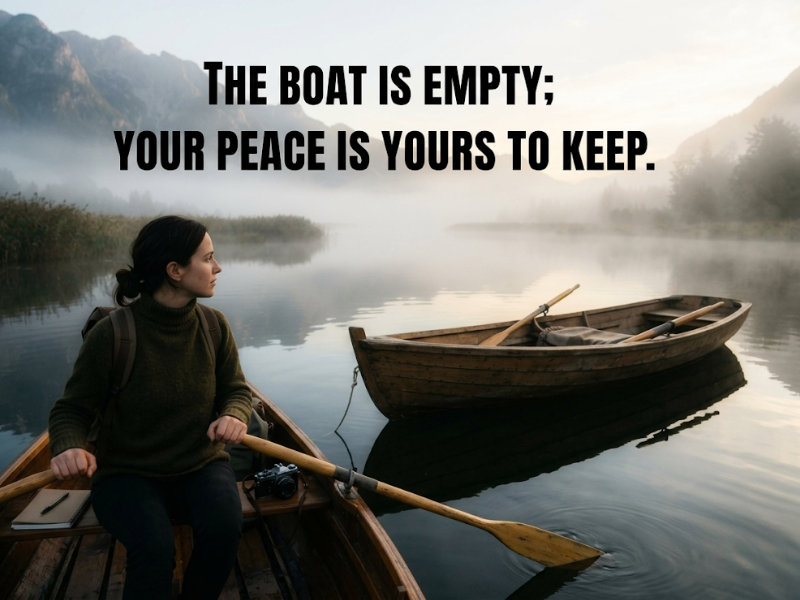
A man is rowing his boat across a river on a very foggy morning. Suddenly, another boat looms out of the mist and strikes his own with a loud thud.
The man erupts. He shouts at the other rower: “Watch where you’re going! You almost tipped me over! Are you blind?” He is ready for a fight.
But as the mist clears, he realizes the boat is empty. It had simply drifted loose from its moorings.
In an instant, his anger vanishes. There is no one to blame, so the anger has nowhere to land. He simply adjusts his boat and continues his journey.
As a psychologist, I see so many people rowing through life, constantly bruised by “collisions” with others. We take the hits, the rude email, the cold partner, the judgmental boss, personally. We assume there is a pilot in that boat intentionally trying to sink us.
But here is the truth: most boats are empty.
- The colleague who snapped at you? Their boat is full of their own burnout and a failing marriage.
- The friend who didn’t text back? Their boat is leaking with anxiety and a mounting to-do list.
- The stranger who was rude? Their boat is tossed by a storm you can’t see.
When you realize that people’s projections, moods, and failures are usually a result of their own internal “drifting” and not a targeted attack on you, your reactive anger dies. You stop being a victim of their turbulence.
Chuang Tzu put it this way: “If a man crosses a river and an empty boat collides with his own skiff, even though he be a bad-tempered man he will not become very angry.”
How to Change Your Perspective Today
- Pause the Narrative: When someone upsets you, ask: “Is this boat empty?”
- Separate the Action from the Intent: 90% of the time, people aren’t against you. They are simply for themselves, or lost in their own fog.
- Choose Peace over Being Right: You can spend your energy screaming at an empty boat, or you can just steer around it.
When you stop expecting the world to be full of mindful pilots, you stop getting hurt by the drift.
Next time you feel that spark of resentment, remember: the boats are empty. Keep rowing.
If reactive anger or constant overwhelm is a pattern you’d like to actually work through, reach out and book a session.